Nova, finally.
watch it large.
posted by dirtylooksnyc at 10:20 AM
0 comments


A space for errant ideas about and around film and art kept by Bradford Nordeen, a New York based writer and film programmer.
 Once you get past the rather irksome security check point a wonderful treat awaits you at the Fales Library and Special Collections gallery. On display until April 29th is a wonderful realization of a window installation commissioned by NYU's Grey Gallery in 1983, then censored before its completion. At the time, Tim Dlugos was a young poet on-the-rise in the Manhattan poetry scene and Philip Monaghan was a trained painter serving as artistic director for fashion haus, Fiorucci. Beginning with Dlugos' crowd fave, "Gilligan's Island," a personal poem which mashed-up imagery from the namesake T.V. show, the Kennedy assassination, Alfred Hitchcock's The Birds and Dlucos own memories of angsty queer teen longing, Monaghan was to create a space that embodied and expanded Dlugos work in painting. As it turned out, the Grey deemed Dlugos' two-line mention of masturbation entirely too much for 1980s public consumption, and shuttered the whole idea, until now.
 Entering the gallery through the narrow corridor, you're met with a rather unfortunate homage to the text. A wall-sized shiny plasticine reprint of the poem bubbles and crinkles on its matching grey wall. With light grey type on a dark grey backing, there's too little tonal distinction between the back and foreground. Impossible to read, the gesture is further troubled by an ipod shuffle deck mounted on the wall, where Dlugos (I presume) reads the piece aloud. I, for one, cannot read a text while someone else is talking at me. Perhaps a better choice would have been to privilege the audio, a more precious fragment from our recent past than some badly reproduced wallscreen.
 Passing the peculiar larger-than-life photograph of a goofy Dlucos in suit and tie, you enter the gallery and suddenly everything comes into focus. Over 54 uniform panels (18" x 24") Monaghan covers all of the wild imagery that Dlugos wearves through his poem. Images where Jackie O mounts The Professor. Ginger - or is that Tippi - looks on, in total fright. The Gilligan's Island logo is trained in the same site as that limousine. Time has afforded an additional process to convey the assemblage nature of this narrative. Beneath the surface of Monaghan's vibrant and youthful painting strokes are inkjet prints of images mostly ripped from the T.V. show, swathed in the candy hued-paints that create this gay teen psyche.
 The paintings are installed uniformly, positioned somewhere between comic book panels and salon-sytle hanging. Their excitable imagery thankfully shies from direct representation, more striving to evoke the ethos of Dlugos wonderful poem. I'm not so familiar with the particulars of Gilligan's Island, but Dlugos mines key sequences, presenting them as gospel, as if their momentous importance is etched into an entire pop subconscious. "From the water comes a thick and eerie tropical silence," near the end of the poem. "The famous conversation is about to start." There's a flippant self-reflexivity to the language that situates us in the space, but just as quickly careens us out to the loveseat, to the red velvet of the theater. Elsewhere, "Rod Taylor and Tippi Hedren are totally concerned. They realize that something terrible is happening. Each has been savagely attacked by a wild songbird within the last twenty-four hours. Outside their window thousands of birds have gathered in anticipation of the famous school-yard scene."
 Devoid of medial mimesis in the 1960s, these queer role models and erotic icons were stolen, adopted, projections. Tippi, Jackie and Ginger are Dlugos, are Oedipal mothers. And The Professor is the dream lover. Is our dream lover. The trauma begotten by the assassination, stirring in the allegorical heart of The Birds, is a ripe one for any a teen faggot, wetting his hand and rubbing one out in daydreams of the boy two rows back in government class. It's like Michael Moon, writing about gay children from earlier generations who took delight in the gendered excesses of Maria Montez and Jayne Mansfield, only in Dlucos swirling cosmology, these figures that inspire a shared breathlessness ebb a bizarre 1960s-brand of pop normalcy. Each figure seems, to me, stoicly banal. Instead, their wildness is in these juxtapositions. Monaghan's works are the hyroglyphs for this rag-tag manner of collective dreaming. And the paintings depict the beautiful and uncanny shock at the realization of a shared gay experience. That the fantasy of one isolated faggot in Dallas, TX is gripping another thousands of miles away. "I realized that I had always had the same feelings," Monaghan writes in the sensational complimentary catalogue that accompanies the show. His paintings are raw, exciting, loving. I'm not sure I'd find them enchanting individually, outside this setting, but as an installation, Monaghan's work is dazzlingly successful. It's a glimpse into a creative space drunk on the erotics and kindred devotions of this shared subconscious fantasy. This firey island where teens of the particular moment that the poem recalls - 1964 - had to read through popular fictions, inserting themselves in the cracks of these sources.

posted by dirtylooksnyc at 5:02 PM
0 comments
 Tuesday. Two shows, on neighboring blocks but worlds apart. On some bed ridden week-day chatter with a friend a few days prior, I was sent a mildly pornogrpahic image of two boys occupying the same fashion-y white dress, one giving the other a blowjob. She'd (my chat friend) just come across the image and didn't know it's maker. She found it way hot. We guessed at the nationality of these boys - I guessed French or German while she was way off the mark with British. Well, it turns out the boys over at Gayletter knew - of course! - and recommended Luigi and Luca's (Italian, duh) exhibition at Leslie/Lohman Gay Art Foundation on Tuesday night. The exhibition was the sort of affair you're meant to just accept given the "Foundation's" self-designation as a venue for thriving gay culture, but I could barely keep my cool in a room flanked by lusty collectors ogling fashion photographs of a hot couple fellating each another and shelling out cash for the sake of "art". The economic arrangement of the show assured that all (most) tastes and price-ranges were accounted for, with a hot-lighted vitrine displaying more edition oriented formats as opposed to those larger works that also graced the walls. And boi was stuff selling. Everything, I know, has its place, and if the "gay community" would like to perpetuate this material being exhibited as its chosen "fine art," than so be it. I'd prefer to call the work ephemera of visual culture. This preferential treatment of commoditizable desire (aka, where desire for the subject becomes equated with the overall value of the work) was what drained the life out of queer cinema in the 90s, so I have a particular axe to grind. To me, the work on the walls was decorative accents, collectables towards the construction of A-Gay lifestyle. I'd imagine it was an art opening those boys on the Logo show A-List would attend. And maybe there's something way positivistic to say about the ability to establish and sustain a kind of gay capitalism for the furthering of gay image production and visual culture. As the Gayletter boys tweeted at the show, there were a great number of NYC queer art mavens on parade - my friend, Max Steele and his counterpart Daniel Portland from band B0dy H1, Gio Black Peter, and, of course, those darling Gayletter boys themselves. Still, I felt completely at odds in this "community" affair as the foundation would have it, atomized apart from this market segment.
 So, I guess I headed over to "my" show, which was a total mind-fuck. The Swiss Institute - hot off their Chris Kraus reading - was opening with photographs by Karlheinz Weinberger, a Swiss photographer who took physique pictorials in the 1950s and documented a 1950s counter-cultural trend in Switzerland - gangs who took up American iconography with a polyamorous ferocity: Little Richard, Elvis, James Dean, Hells Angels, Nazism - well, I guess that's not really American. Like the Bikers in Kenneth Anger's Scorpio Rising, the subjects of the exhibition, "Intimate Stranger" work with loaded visual signifiers in an echolalia of attitude. Not only do the counter-culture carnies in Weinberger's photographs tote these cultural referents, they fashion their own rag-tag regalia by pasting magazine cut-outs on 7" brass belt-buckles, self fashioning horseshoe codpieces and lacing screws through the flies of too-tight jeans. The fandom on offer here isn't a kind of fidelitous obsession, it's an immediate and beautiful kind of devotion to a mythical foreignicity, a lifestyle that in America was really only an ideal, never a possibility. When Kenneth Anger returned from an 8-year stint in Paris, he made Scorpio Rising because he discovered an alien America, an America driven by these new rebel images that (particularly in Anger's work) flirted like a pop-cultural Thanatos. There's a palpable mix of femme eroticism and violence in Weinberger's images, as these tough guys with swastika armbands and facial scars, pout and pose like drag contestants before a backdrop. The Institute was smart to offer cans of Budweiser for the opening and the hipster attire of various crowd members made the show feel immersive. I met filmmaker Theis Ulrik Jessen in the lobby and also wrangled a press copy of Rizzoli's accompanying catalogue: Rebel Youth with a forward by John Waters. Review forthcoming. THE SHOW IS A MUST-SEE.

On Wednesday I showed off my culinary skills to some lovely writers and film folk for my first formal dinner party at our E Williamsburg abode. Yes, girl, I tried my best to expand these Bachelor cooking techniques to include chicken and dumplings and pumpkin pie - and from scratch! Well, I came away with a laundry list of movie recommendations... though most mysteriously involve actresses having sex with monkeys.

 On Thursday I had a beautiful New York day. Just having received the flyers for the upcoming William E. Jones / Fred Halsted edition of Dirty Looks, I went to go flyer my life away, all over town. It's very icy here, but when you're on the move, it don't feel that bad. First stop, I picked up some new black jeans that I was having altered and walked them to Participant, where Lia Gangitano was revving up for a the School of the Museum of Fine Arts, Boston's College Art Association reception. CAA is having their mega-conference in New York right now and I'm not going. I even worked there last year, so getting in on a dime wouldn't be an issue. I'm just in a really oppositional mood to academia at the moment - which filmmaker and queer ambassador Ira Sachs chided me over later that night - but I'm getting ahead of myself. I changed into my new jeans in the Participant bathroom since the holes in my uniform black jeans were really getting dire and popped out only to run into Photi on the street, director of Callicoon Gallery. He's so nice. I dropped flyers off at the Quad, at Kim's video. I tried Anthology but they weren't open. Basically, I walked across town on a brisk but lovely sunny Thursday, stopping by Zürcher Studio, to chat up the gallery assistant about their impending art fair alternative, Salon Zürcher, a more individual response to the Armory Art Fair week. Popping into various other institutions to drop off my cards, I finally settled into a cafe in the West Village where my friend works and we kibitzed for an hour or so until I made way to the opening of I <3 Boy a new book launching at The Powerhouse, in Dumbo. The opening was sufficiently mobbed and I was able to catch up with Timmy Pico, tireless harbringer of Birdsong Mag. Tommy's moving to Paris - lucky - for the summer, to beat the heat (and hopefully some Parisian boys while he's at it). I think tommy's micropress efforts with the zine are great - and will only improve with an international ratchet on the belt.
Attending with my friend Herbert, he convinced me to go back to Julius cause I read an invite wrong and though that the CAA Queer Art Caucus social was Thursday night. So we went and had burgers, trying to figure out who was CAA. None were. It was Friday night. Silly me. But we were joined by my friend Chad and a present surprise found Ira Sachs and his lovely BF, artsist Boris Torres, who I've heard so much of but never met, stopping by. I had a lovely chat with Ira, who I've been quite fond of ever since I wrote a piece on his Charles Ludlam evening at Queer/Art/Film. A truly staunch supporter of queer community politics, Ira's always a great conversationalist and very supportive. Suffice to say, what was meant as a quiet evening ended at 4 am.
 Which left me a wreck for Friday. Though I was able to make it to my friend, Zackary Drucker's presentation with Flawless Sabrina of Zackary's new film, 'At Least You Know You Exist' and the 1968 documentary starring Flawless, The Queen alongside Joe Jeffrey's 'The Queen: After Party Outtakes.' The West village LGBT center, which hosted the event, was PACKED. Hundreds of people turned out for this event. Attending the screening, you're privy to a kind of kindred love affair between Zackary and Sabrina. To me, true queens are the ladies who don't shut themselves off inside a role, but are constantly changing, learning and teaching, which is something that Flawless highlighted in her conversation. Zackary's film looked immaculate shot in 16mm on a wind-up Bolex. It's more a rumination too, and the difference between Flawless' performative hijinx and Zackary's high-gloss modeling does stand out. Like many contemporary artists, Zackary's body (and body of work) has become more a platform to discuss a queer (trans) history and how that has shifted over the years. It's become decidedly more marketable as a cultural product, a trait always in evidence through Zackary's haute couture stylings. But to deride this is missing the point, which is celebratory and educational - like William E. Jones, Zackary is manning an archive and attempting to work these personal histories into his film, performance and photographic practice. A highlight of the evening came when a question emerged from the audience regarding Zackary's nude performance in the film. "That was so erotic," a female commentator asked, "is that the first time you've been nude in film?" Ever the performer, Zackary allowed a slight pause to become pregnant before extolling, "It's not the first time..." "And hopefully it's not the last," cooed Flawless.
 The straight-forward doc couldn't help but make me think of Rupaul's Drag Race, which is really very good this season. I've been joking recently that I don't know how I know life without it! But The Queen exists as both a cultural artifact while conversely showcasing how quite a bit seems rather unchanged. Of course, the idea of pageantry is really conservative, so the almost identical format from this 1968 Town Hall performance to Ru's stage presentations is not a huge shock. There's a pretense towards agency in Ru's show, where the girls must exhibit creativity in overcoming challenges, though it's frequently thwarted, as in the case of that odious winner last year, who displayed the same kind of flaccid "realness" mimicry that Queen winner Harlot exhibited onstage. In street footage, Harlot was fascinating, but the kind of messy identity politics that are frequently bubbling under popular drag contests still exhibit some ugly shadows of hetero envy 40-some-odd years later.
posted by dirtylooksnyc at 4:09 PM
0 comments
 Sometimes when life hands you a wild juxtaposition, you just have to play it as it lays. On Friday night, I attended my friend Larin Sullivan's 30th birthday party - it was Love Boat, or rather Lez Boat themed. Perhaps more importantly, it was literally two blocks from home so I spent much of the evening working on projects. Then D reminded me that Netflix came. I rushed to the little red envelope, knowing its contents. Tearing it open I popped on our evening's entertainment: The Twilight Saga: Eclipse. Now, I'd seen the last one a while back, even wrote of it on these pages. I'm no fan to the series, really. Never read the books, but as someone deeply invested in pop cultural forms, I'm more than happy to follow Bella and her occult posse into the dimmest Pacific Northwest forest and back.
 It seems difficult to fathom, but things have become decidedly more industrial this go-around. And it's tricky to pinpoint why, but the kids are remarkably less sexy. Orbiting in their own cosmologies, these actors don't even seem to be participating in a film, but revealing their make-up and hair perf forms for a worldwide mirror. Perhaps its because the respective frankness and pop-existentialism that characterized these poorly fleshed out male love interests have become more punchlines than signatures. Constant in-jokes riddle the script, which jibes at hottie werewolf Jake, "don't you own a shirt?" so apt is this actor to parade his lupine physique. When Bella braves frostbite, Jake cuddles up to warm her, even though she's betrothed to the vampire because, "you know I'm hotter than you."
 And he's right; R Pat has never looked so uncomfortable and pained. His Edward displays nothing but a desperate, whiny devotion to this all-important Bella (one must ask oneself why everyone goes to all this trouble for one maudlin little brunette). But these in-jokes save the day. These jokes reach beyond the bizarrely connect-the-dots script. Oh, Eclipse is a surprisingly enjoyable watch, it's absurd as hell, but I was riveted. It's really Soap logic - and that I adore. But these jokes, almost Shakespearean in their address to a world beyond the diegesis, hood-wink a thriving international audience of tweens to whom this conservative cosmos has become gospel. They create a metatextual layer on this series so that it becomes participatory, so that giggles can run though the audience, giggles that acknowledge space beyond of the dour perimeter of the Pacific Northwest.
 The following evening, I engaged in a different participatory event, no less rabid or targeted in its market (way gay). She's come a long way since last summer's gig at Webster Hall, whose bill she shared with Kelis, but Swedish pop diva Robyn sold out the Radio City Music Hall, delivering to a packed homophilic house - the largest, she beamed, that she's ever drawn, by herself. Everything was bare-bones in an endearing way. Her two opening acts were solo performers, one of whom sang exclusively to a tape (the meh Natalia Kills). Two large pinwheels were Robyn's sole decoration. But she brought the crowd roaring to its feet as she entered the stage in a doctored fireman's jacket and platform Timberlands, launching into her Max Martin-produced 'Time Machine.'
 Of course, the thrill of the night was the stellar single, 'Dancing on my Own,' which, as in last July's performance, came very early on in the set. I imagine it's what opening night at Eclipse felt like. The entire crowd just swills together on the thrill of hearing this, their song. It's a loner song, so it's your song, which makes it feel all the more ecstatic when 5 or so thousand people tap into this with you, sharing your unmitigated delight. And Robyn works hard to make her set feel all about you. She has the rare quality of a performer who can address an audience and make it feel direct, intimate. Diana Ross has that, too. She takes every opportunity, 3 or 4 times a song, to visit with the front row, dipping her hand in or slipping down into the pit. Last night she tore up the rafters alongside the theater, all the way up to the balcony, throwing herself into the gaping arms of those fans who only made it second tier. She don't care!
 In truth, it was a slightly less taut show than the one that she performed with Kelis. Her performance style is nothing short of buoyant - she jumps, runs, dances like a little Swedish she-devil, all without missing a note (last night she even toppled over, falling on her butt during 'Call Your Girlfriend' - there too without a second's lag). But she's also been touring an entire year now, and there's a mild fatigue there. She's performing material, mostly culled from the Body Talk series, with all of Part 3 on offer. She sounds good, looks good, but, as in Eclipse, it's the moments where she dips outside the idiom and just revels at her accomplishments with her fans that makes the evening so memorable. Her smile cuts through the music, this dancing and joy feels like the point, the music a platform for it.
posted by dirtylooksnyc at 10:28 AM
0 comments
 A week of icy eventage. A combination of mild warmth and ice rain makes every surface here glazed in a swath of silvery white, resembling either marshmallow fluff or a Cocteau Twins album cover. It's beautiful when you're not falling on it.
 On Sunday I went to the Swiss Institute where Chris Kraus read with Jeremy Sigler in celebration of her new book "Where Art Belongs." She read the last piece which had some startling connections to D - in the piece she weaves a fantasy narrative around a boy jerking off in a photograph. His name is Derek, she decides, and she's reading the same William Gibson novel that D read last summer - while we were in similarly sunnied climes. Just one of those momentary things. There were lots of people there and I FINALLY got a chance to talk to Chris face to face, afterwards. We've been emailing one another for years now. She was shocked that I had the original edition of I Love Dick, the one with her hilarious glamor shot on the back cover. We got a brief coffee and kibitzed about hating London and changes in the LA art scene.
 A coffee followed the next day with curator Joseph Whitt (whom I adore) and we decided to collaborate with me writing a chapbook for his new micropress, T.M.I. Love it. Later that night, I went over to the Half King to listen to poetry and lust over issues of Bomb, now that we've let our subscription lapse. Justin Taylor, Dorothea Lasky, Ben Mirov and Luke Degnan read, and I was particularly taken with Lasky's work. She looked out to the crowd, for some reason isolating me when she asked "I hope you like Sylvia Plath." I do, but didn't respond to such a generally issued question. She took this as a no and delivered some stand-up comic retort. Then we scuttled over to the Annie O Music series at the Cooper Square hotel for an evening hosted by the gallery that I am curating Dirty Looks for, Participant Inc. Death Vessel played - a decidedly more country outfit than the name might suggest. Eileen Myles, Matthew Higgs, Gary Indiana were there and I chatted up Conrad Ventur about - what else - Warhol cinema and had a brief chat with Photi Giovanis, who runs Callicoon gallery in Callicoon New York. Participant director Lia Gangitano looked great - not wearing her fur vest and leather jacket uniform, but a strappy dress. The view up in the main sweet of the Cooper was really amazing.
 It's ice raining here, so I didn't leave the house on Tuesday. I was meant to have plans but they fell through and I got a take-out burrito and watched Joan Crawford and Clark Gable roam the jungles in Strange Cargo which was kind of not that great. The next night I got sushi with a friend and set up shop at the Boiler Room, running into friends and strangers.
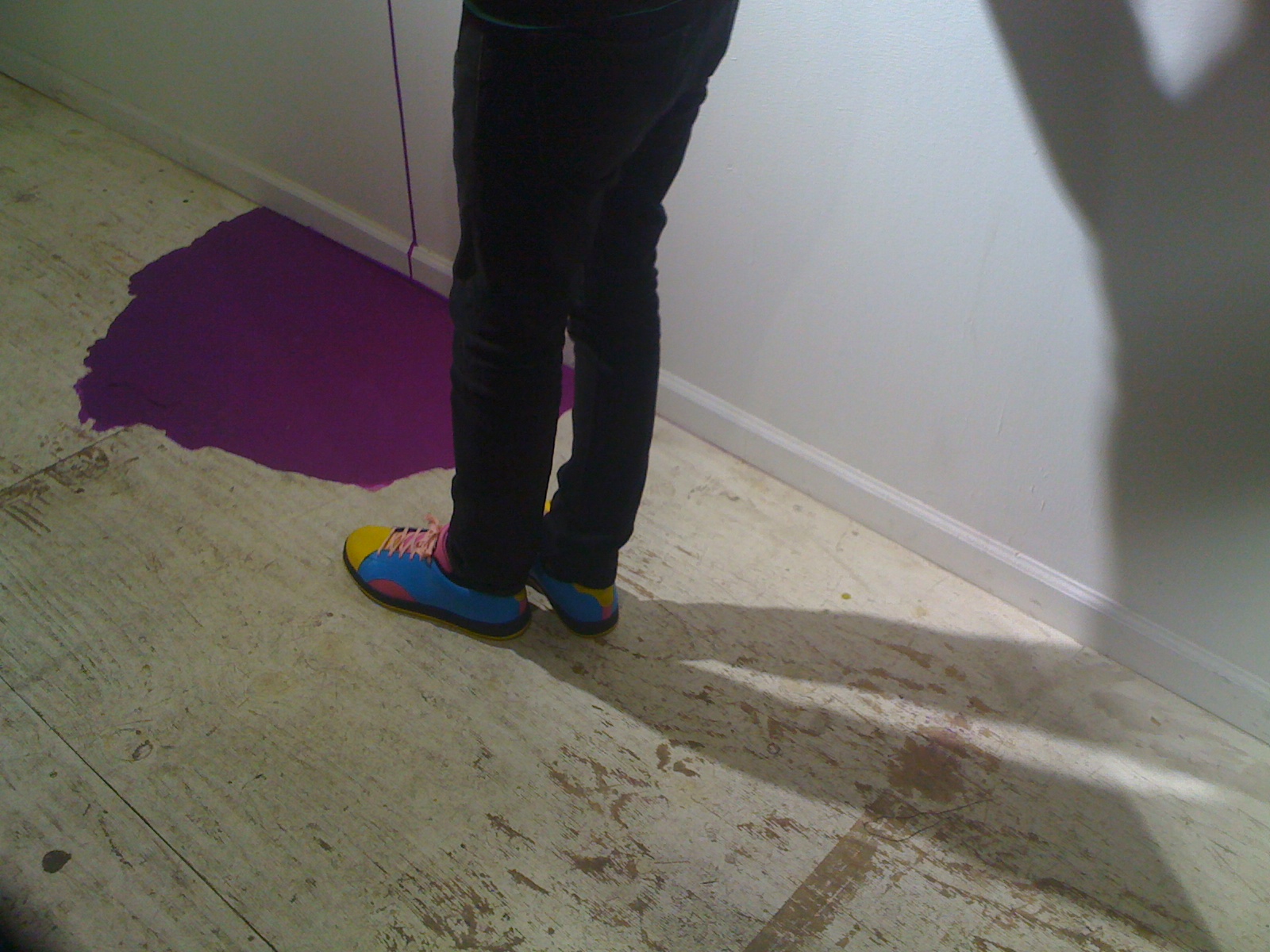 Last night I headed over to NP Contemporary Art Center to meet up with a crew of curators - Joseph and Herbert Mendoza - to check out Thomas Dozol's show. See, he's Michael Stipe's boyfriend and there was Michael, in attendance, and wearing some rather scraggly facial hair. John Giorno was also present WITH KIM CATRALL. Sadly, like that time I ate a burrito for an entire meal sitting next to Paul Rudd at El Conquistador in LA and never noticed, I totally missed Kim. But thems the ropes. We hung around long enough to find out from gallery director Wesley Stokes that my new thrift store shoes are made by Pharrell. Though here in the photo, D models them. Then we headed over to P.P.O.W. to see their new space in the Yancey Richardson/Electronic Arts Intermix building. We were promptly given the tour by director Jamie Sterns who was SO in her element, whisking us about abruptly with an energy level that was never short of amazing.

Grabbing a slice at the new Artichoke pizza, we cabbed it over to Julius for a new party Stache Bash where we were given surrogate staches which I modeled for the remainder of the evening. We parted ways with Herbert, since we were on a mission - see, Joseph had never been to Nowhere or Phoenix, New York gay bars that I suppose are "alternative" (whatever that means) but have always been a part of my NY landscape even on visits. So we probably drank too much and courted a visitation from a drunken mary at every bar, to the tune that I joked with Joseph this morning that our night was something like A Christmas Carrol. Jewelry designer Blue Bayer was by far the most endearing - or maybe I was just so far gone at that point. I can recall his calm loving demeanor this morning, so I guess that says something.

posted by dirtylooksnyc at 12:45 PM
0 comments
 More snow and still we trudge on. Last Tuesday, my friend Christopher, aka Lonely Christopher whose collection of short stories, "The Mechanics of Homosexual Intercourse" has just been published on Dennis Cooper's imprint on Akashic books, had a reading at St. Mark's books with none other than Genesis P Orridge. Despite feeling well under the weather, I attended on a "warmish" day with my artist friend, Jake Davidson. Chris came in late and confusedly b-lined to my familiar face. "I don't know where to go?" "Don't worry," I hugged, "Just walk back there and tell them you're Lonely!" Christopher gave a heady reading, not from his book but from a play accounted by pre-Stonewall homos. Very semiotic based stuff. Then Genesis gave a "reading" from her "The Psychic Bible," which basically meant we were serenaded by Genesis' off-the-cuff accounts of communal living, creative insights and incitations. As is usual, she was fabulous and inspiring. I still want to join a commune! Though, I kind of did before Gen, ever since I saw that final scene of Rosa Von Praunheim's Nicht der Homosexuelle ist pervers, sondern die Situation, in der er lebt (that's It Is Not the Homosexual Who Is Perverse, But the Society in Which He Lives to all of us non-German sprechters). So, cute agit gay-boy communes, my email is contactbeingboring@yahoo.com. I'm so there.
 Then the snow turned to rain and Wednesday rolled around. That's right, it was the inaugural screening the monthly experimental series I am organizing, Dirty Looks! Given the weather and a swarm of last minute text message regrets, I was certain that the outcome looked bleak, but out folks came and in droves. Leading the discussion after the Films of Curtis Harrington, Bruce Benderson showed up, and many friends did pop in: playwright Brian Bauman and his beau, Christo Allegra, curators Joseph Whitt, Adam Baran and Herbert Mendoza, artist Mark Golamco, Robin Newman and his writer BF Max Steele came with Daniel Sander, journalist Suleman Anaya and the fabulous Julie VS. As a curator it's particularly rewarding to see an array of strangers in the audience - that the program you've assembled brings people out of the woodwork. And out they came. We ran out of chairs at Participant Inc. so director Lia Gangitano, Earl Dax and I had to stand for the program! Apologies to those in attendance for the frosty interior. A common complaint from the crowd of the otherwise fabulous Participant (as Lia too well knows) was its lack of heating. A real downer in January. But the films screened and everyone seemed very keen. Even the exhibition, a video installation by artist Glen Fogel, went with the Dynasty screening to the t. All in all, a great evening.

 On Thursday, I had to return the films to Filmmaker's Co-op where I found MM Serra and her staff outfitting Video Barbie with a transexual beard which they'll premier at the Underground Superstars' closing party at the Gene Frankel theater tonight. "She needs a dick!" MM started. I named her Video Barney in lieu of her Video Bert. They agreed. Somewhere in there, I found the time to turn in my recommendation text about Johnny Guitar for the upcoming issue of Little Joe, out April 5th. Later, D and I skedaddled over to BAM for the premier of the new Gregg Araki film - as you no doubt have seen from the prior post. Kaboom was great. Gregg was in attendance - actually he held up the screening since he was coming straight form JFK! Robin and Max were there so D and I saddled up next to them and ate some free popcorn ("Courtesy of Chase" - well, I'm already a fan of Chase, thanks, for recently depositing $125 into my new checking account!). We ran into Marc Arthur who was bummed to have missed Dirty Looks. But then we had to run over to Louis V E.S.P., to meet up with my performance partner Hayley Blatte, where we did a screen test for Friday night's taping of the pilot episode of E.S.P. TV. I created a character based around a joke - see, they needed a host for this public access video show they were doing and that D was participating in and I quipped off-handedly, "Well, I'd do it, but only if I can be cable access sex-Queen, Robin Byrd!" To which the ever-savvy director, Scott Kiernan, said "Done!" So I invented this character - Mary Boom! - a mix of Robin, Mary Boone (obv) with a little bit of Ann Liv Young's Sherry thrown in there for snarky criticality.
 Apparently I was so good at that some asshole at the taping "complimented":
"You're so good, you're out of your element but it seems like you mastered it!"
"Excuse me?"
"Well you know, it really seems like you get the art world," he talked down to Mary - like every fag in a wig is some total twit. Attending to these (primarily hetero) experimental performance pieces, this fucker couldn't get that Mary could be a critical performance, too, a sex-worker allegory for the art world. Sternface thought that I was some tranny wreck hired for hilarity.
"Listen fucker," I told him from the bathroom line, "I am a curator!" He stammered.
 Of course, Mary Boom! did not ebb art world sophistication - but that was entirely the point. The whole taping was a hot mess in the fabulous way that early public access broadcasts typically are (minor tech foibles, aside). Mary was the medium specific glue that bricolaged the diverse performances and/or videos by KUNSOLE, Elbis Rever, Dana Bell, Victoria Keddie, Sam Mickens, Colby Bird, Kate Gilmore, Jennifer Sullivan and Andrew Steinmetz, Katrina Lamb, Erica Magrey, Sophia Peer, Brian Zegeer, Derek Larson, Ganjatronics, Jonathan Phelps, Andre Prkowski and Rachel Mason. Like this VIP art fair, which seems to be suffering even more technical glitches than our humble outfit, Mary opened her stable to give the Manhattan Neighborhood (!) Network a taste of what was hot, and with her resident artist, Coco (Hayley) we interviewed my roster in much the same way Byrd would, flirting with the Ganjatronics boys and dishing about enemas with Elbis Rever. Of course, the whole thing dissolved into one big dance party at the end, with even the live studio audience joining us on "stage" for Mary's theme song: "Boom Boom (Let's Go Back To My Room)" by Paul Lekakis.


After that busy week, tonight - my ass is staying in. I gotta get some rest, but believe you me, I'll be seeing you tomorrow at the Chris Kraus' book launch at the Swiss Institute. I'm a total slut for all things Chris Kraus and she's ever so nice to reference my book Fever Pitch in artschool grad crits and Australian catalogue essays. Why don't you just go buy her new book, "Where Art Belongs" now!
posted by dirtylooksnyc at 12:40 PM
0 comments
 I was sitting at BAM last night for the New York premier of Gregg Araki's new film Kaboom realizing that I was never quite the age bracket that Araki's most coveted films depict. Happening upon The Doom Generation in my way-early teens, I was drawn like a moth to the flame by a post-it on the vhs rental box that read: You must be 18 years or older to rent this! I knew the store crew, who had already rented Pink Flamingos to me out of their porn section, so I didn't and watched it at my rather impressionable age (12 or 13?). Nowhere, too, came out when I was in junior high, the mess that predates all of Araki's characters' college-year crises. More a hormonal soup than an identity blitzkrieg. Then he dropped out of that mission for a while with the threesome movie that coincided with his surprising affair with star, Kathleen Robertson and, after the failure of his unaired MTV pilot, This Is How The World Ends, nothing materialized until 2004's Mysterious Skin. My prime teen years faced a dearth of new teen traumas from the harbringer of the Teen Apocalypse Trilogy. Where was Gregg when I needed him?
 Watching Kaboom last night made me realize there's no teenage neo-realism, here. My teen cultural moment was never documented by Araki, but then, I don't think any really is. Even though Kaboom sports Lady Gaga references, his new teen dream is more like his depiction of Los Angeles: a moribund place of technicolor limitlessness and impending doom. Araki's teens are a total fantasy state, serving up the best of the best (sex) and the worst or the worst (death).
 Kaboom is being heralded as a return to his roots, it's a teenage Twin Peaks sex fantasy that takes a lot from the format that Araki found his greatest success in - straight-to-video 90s releases. Movies with loose ended plots, sexy children, familiar scenarios and neon VHS box covers. Smith, an *ahem* 19-year-old film studies major, hops from boy bed to girl bed and in between somewhere witnesses a horrible murder by animal-masked men. Unable to recall specific details of the night before (he'd inadvertently consumed a laced star-shaped cookie), Smith searches for the red haired girl who was knifed and evades the dangerous figures who lurk behind every open door. Oh, he has loads of sex too. With Kaboom, Araki reminds of his reputation as an adept cinephile. It's a terrifically fun watch and completely aware of all of its generic referents and stolen formulae. It's also a terribly beautiful film, awash in the rich candy hues for which Araki is well know. Now, though, as Dennis Lim suggested in his recent NY Times article, "Young and the Restless Never Get Old", the warmer tones reflect a more optimistic sensibility, in contrast to the acidic pop tones of his nihilistic yesteryear. Of course, underneath The Doom Generation and Nowhere beat a loving and endearing pulse, clued in to more than the sardonic dismissiveness critics frequently mistook his cinema for. It's been luscious pinks and blues since Mysterious Skin and that suits the filmmaker.
 He's always been a closet romantic. James Duvall's Dark yearns for love in Nowhere with a kind of fundamental innocence that can't help but infect the overstimulated spectator. Here, there are similar moments. Araki was making movies before the commercial onslaught of coming-out films of the late nineties and it was particularly heartwarming to see teen gay affections rendered on VHS. My heart warmed to find that Kaboom still finds room for this kind of glee. A cutie named Oliver that Smith spied at a party shoots him a flirtatious email video message and the smitten smirk that crawls across the recipient's face is totally believable. It captures the ecstatic potential of youthful flirtations, a kind of fairytale longing that is less existential than Araki's former incarnations. And on the upside he no longer feels the need to make the lover explode into a giant bug nor does he shear him of his manhood. They oggle one another and grin across the interweb, locked into this sexual current that seems to pulse through the air of Araki's campus life.
 Kaboom is definitely independent and it showcases this frugality in its slim cast. But while endless cameos were his way around budgetary restraints of yore, it's nice that Araki trusts in the good dozen actors cast in lead roles. Kaboom came out of Araki's attempt to pen an MTV series. A pilot was shot for This Is How The World Ends, but it was way to reiterative of Nowhere, replaying jokes, scenarios and characters from that far more successful venture. So, like David Lynch with Mulholland Drive, Araki got a check from the French (bless 'em!) to turn this serial into Kaboom. That probably explains the presence of Catherine Breillat veteran Roxanne Mesquida, who plays a crazy lesbian girlfriend with occult powers. It also explains the abandon with which Araki hurls into comic book situations. He explained in a q&A after the screening that, since the French were footing the bill, he didn't conform the narrative to a appealing American product, but top-loaded the text with everything that he would want to see in a movie. There's loads of CGI on display here and wild plot turns display an assured what-the-fuckness that is really awesome (prepare yourself for an exhilliratingly wooden and high-octane exchange between James Duvall, who plays a stoner RA, and the quirky lesbian best friend, Stella [Haley Bennett] in the final minutes of the film - a scene so ecstatic in its b-movie timing that I audibly convulsed with pleasure, startling cinemagoers in my adjacent seats).
 There's kind of a bad ending, but there's ultimately nowhere for the movie to really go. It's a retread, a reinvention, an explosion of Araki's past that's both dazzling and meta. Not that you need to know his prior work to enjoy it. This is what Araki's done best all along. Hopefully some ignorant tween will find this on thepiratebay (or some more egalitarian screening site) and revel in the contours of its sugary angst over stolen midnight viewings. Hopefully this blast of jouissance and outsider freedom will clue them into the alternative lifestyle options that Araki's cinema has always championed.
posted by dirtylooksnyc at 12:01 PM
0 comments
 You’ve seen Burlesque already. Maybe you haven’t walked down the street and saddled up to the ticket booth, announcing your guilty intent to the judgmental ticket salesperson. But you’ve seen it. Burlesque comes from a long lineage of movie/musicals like Chicago, Moulin Rouge, Chorus Line, Fame and, yes, Showgirls. Some were successful, others… not so much. Yet on what basis? Every sour review of Burlesque (and there were many) ridiculed its unoriginal storyline, its paint-by-numbers screenplay, its recycling of familiar forms. Manohla Dargis hilariously called the film “a savvy combination of a Disney tween program and a Lifetime weepie.” But on what canon is one really supposed to judge a film like Burlesque, anyway?
 Burlesque sports a narrative so banal that it’s beside the point to even go into it here. Blond girl in Iowa… aspirations… Los Angeles… Cher. And it moves along quite like that, aware, and in everyone’s best interest. We know the story and it’s not what we’re here for. It’s the motions! The film replays the opening to crowd-pleaser, Chicago, finding a blond shyly gazing into the limelight. The scene also proves that it is, in fact, more pleasurable to see Cher on stage than that Catherine Zeta Jones. Cher will later sing the (GOLDEN GLOBE WINNING) Diane Warren song “You Haven’t Seen the Last of Me,” á la Jennifer Hudson’s “And I’m Telling You I’m Not Going.” Veronica Mars actress Kristin Bell lipsyncs like Moulin Rouge’s rehash of the showgirl showstopper “Diamonds Are A Girl’s Best Friend.” It's all familiar. You get the idea.
 This is the much-publicized first acting effort from Christina Aguilera, who does just fine in her few dramatic moments. She’s game as hell and a cipher to the T, all baby-faced and blond. Cher and Bell are entrusted with most of the histrionics, graciously leaving Christina to belt out five remaining musical numbers from her (to quote the film) “mutant lungs.”
Many critics blasted what they felt was the film’s patchwork format, how these scenes, bolstered between so many aural eruptions, felt like mere vignettes. They’re neglecting a musical mode currently more relevant than the traditional musical. The night before I attended my screening of Burlesque, I, by fortunate happenstance, watched Kylie Minogue’s Showgirl: The Homecoming Tour dvd. Now, in arena spectaculars such as Kylie’s, favored hits are strung together with sensational sets and a light-handed nod at narrative sequencing. Each thematic episode lays siege on the most conventional storylines and recognizable touchstones of contemporary culture. These mammoth events, now the norm for pop divas the world over, are well-oiled machines, purely professional arrangements to inspire fits of ecstasy throughout a sea of international attendees.
 Burlesque, which is directed by the man who brought the Pussycat Dolls to our small screen for the reality show Search for the Next Doll, seems more akin these such Vegas-style vehicles than more traditional narrative efforts like Cabaret, Sweet Charity, or Moulin Rouge, even. So driven to please in the most perfunctory fashion, Burlesque is something of a fascinating symbiosis between these forms. Its drama is mild, never reaching beyond what’s required to bring us to the next showstopper. So being, it never achieves the kind of narrative prowess that makes fabulous messes in films like Striptease and Showgirls. But that’s because the film is too pop, or amenable to cause that brand of surprise. Its story doesn’t thrill, but brings a satiated grin of delight to the lips.
This expansive approach towards the musical is not that far from Mamma Mia!, the play-then-film that was begotten from a handful of ABBA songs. The production leaned on its recognizable score and famous, non-singer cast, haphazardly assembling dizzying production numbers with a shimmering gaudiness that befits Greece in June. Mamma Mia! made all of that British money from hen parties; ladies who love the songs of ABBA assembled to sing along to their favorite tunes; karaoke mammas who find Pierce Brosnan’s lack of singing talent a humanizing trait, as though he were taking part in their shenanigans.
 I saw Burlesque in New York’s Chelsea, which turned out to be something akin to seeing Mamma Mia! in London’s West End, surrounded by screaming and swooning gay men in lieu of crooning hens. It’s immersive. Like Mamma Mia!, Burlesque is an event film. Released on Thanksgiving, it’s tailor-made for the kind of escapist diversions that characterize holiday entertainment. It’s flashy, fulfilling and utterly predictable.
I’m the target audience this time around, it seems. Though, I’m not sure if that’s intentional. I’m sure the studio would prefer the film as a post-turkey family destination. And yet it sports a similar sensibility to other recent mainstream offerings aimed at women and helmed by openly gay men. Just like this year’s Sex and the City 2, Burlesque doesn’t feel so much like a film for or about women as it does a kind of ecstatic gay role play; or, what Lindy West hilariously calls it, in her Stranger assault on the former film, “essentially a home video of gay men playing with giant Barbie dolls.”
 Burlesque parades an aesthetic that’s at once hyperbolically glitzy, like a Cher Farewell Tour, but also somehow low-budget, like West’s “home video” or Dargis’ “Lifetime weepie.” The scenes are sweet and go down easy due to their complete conventionality and the men sparkle like confections. Fortunately, Antin has set to work a crew of very competent actors in his gingerbread parlour (joining Cher, Aguilera, and Bell are Stanley Tucci, reprising his Prada role, Peter Gallagher, Eric Dane and Alan Cumming, doing his best Justin Bond imitation) and its nice to see them carry on in the well-worn grooves of the showgirl tradition.
 ‘Cause, let’s face it, since the apex of this universe is a danceteria on the Hollywood strip, the ambitions of the film are nothing short of modest. Burlesque doesn’t invent a wholly different genre of musical. It evinces the evolution of the genre in the wake of chart-topping Beyoncé concert DVDs and retread musicals like Moulin Rouge, Mamma Mia! and Hairspray. It pastiches elements from every point in showgirl history, finessing a new blend of same-old, and achieving its goals in the most satisfying manner. It’s in this capacity that Antin’s film resembles more modest musicals from the old studio system, where ticket-buyers would pay to see their favorite stars in parts reminiscent of prior pictures (Cher) or popular singers making their film debut (Xtina). It also plays out like VH1 storytellers. Set on a sparkling, but humble stage, Cher and co. deliver the goods this holiday season by reflecting on past triumphs and redecorating them with a polite flourish of glitz and glamour. You may not be able to turn back time, but sometimes it’s awfully sweet to retread it.
posted by dirtylooksnyc at 2:00 PM
0 comments


